


Creatine - 90 Servings
Creatine - 90 Servings
BUNDLE & SAVE
Couldn't load pickup availability


-
Ordered
- - -
Order Ready
- - -
Delivered
Directions
Directions
Daily Use: Pour 1 stick pack into 8-12 oz of any liquid. Stir or shake until fully dissolved.
Timing: Take any time of day. Consistency matters more than timing. Many customers add it to their morning water or coffee.
tine saturation typically occurs within 2-4 weeks of consistent daily use at 5g/day. Benefits include improved strength, recovery, and cognitive function.
Dissolving: Unflavored creatine monohydrate dissolves best in room temperature or warm liquids. Stir thoroughly. A slight grittiness is normal and does not affect efficacy.
Results: You may feel hydration and energy benefits within the first few days. Full creatine saturation takes 2-4 weeks of consistent daily use.
Consistency: Creatine works best when taken daily. Make it part of your morning routine.
What you should know
What you should know
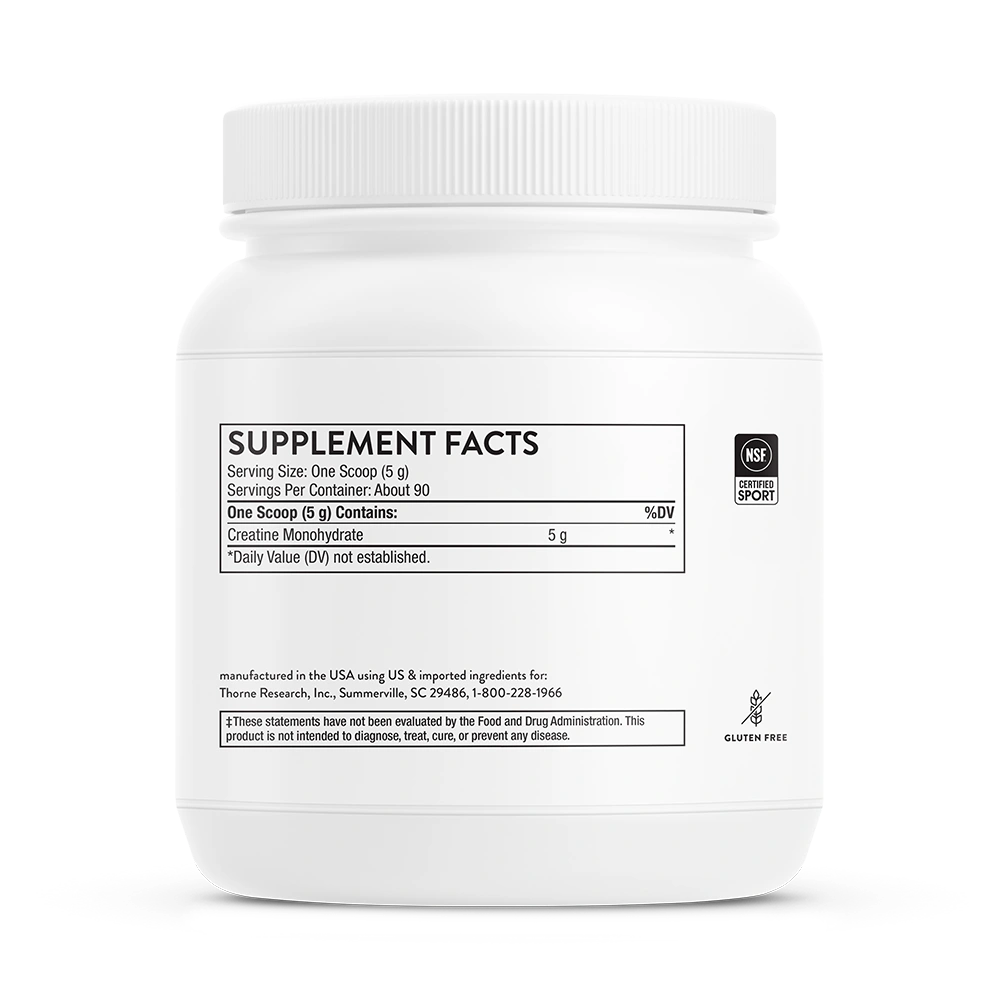
Features a highly researched, micronized form of creatine monohydrate that is easy to mix, colorless, odorless, and has enhanced solubility. NSF Certified for Sport®, ensuring rigorous testing for quality and the absence of nearly 300 substances banned by major athletic organizations. Suitable for athletes and individuals with increased dietary needs or those not consuming enough creatine-rich foods.
Tested for quality you can trust
Tested for quality you can trust
Because athletes need to know their supplements are trustworthy and compliant, every batch of an NSF Certified for Sport® product is tested for compliance with label claims and to ensure the absence of nearly 300 substances banned by many major athletic organizations.
What sets Thorne Creatine Monohydrate Powder apart
What sets Thorne Creatine Monohydrate Powder apart
- NSF Certified for Sport®
- Easy-to-mix
- A highly researched, micronized form of creatine monohydrate
- Colorless, no odor, and enhanced solubility

Creatine - 90 Servings


Muscle strength
Lean muscle mass
Focus & sharpness
Cognitive performance
Cellular energy
Muscle strength
Lean muscle mass
Focus & sharpness
Cognitive performance
Cellular energy
Muscle strength
Lean muscle mass
Focus & sharpness
Cognitive performance
Cellular energy
Muscle strength
Lean muscle mass
Focus & sharpness
Cognitive performance
Cellular energy
Muscle strength
Lean muscle mass
Focus & sharpness
Cognitive performance
Cellular energy
Muscle strength
Lean muscle mass
Focus & sharpness
Cognitive performance
Cellular energy
Muscle strength
Lean muscle mass
Focus & sharpness
Cognitive performance
Cellular energy
Muscle strength
Lean muscle mass
Focus & sharpness
Cognitive performance
Cellular energy
Support for today & the decades ahead.
-

STAY STRONG
Strength · recovery · lean muscle maintenance⁺ ·
Muscle is more than performance. It's what helps you stay active, capable and confident in the way you move. But muscle loss accelerates with age.
Creatine reduces muscle protein breakdown⁺ and has been clinically studied to support strength⁺ — supporting the physical foundation for healthy aging. -

STAY SHARP
Mental focus · attention · cognitive performance ·
The brain consumes ~20% of the body's energy, making it one of the most energy-demanding organs. Changes in brain energy can affect focus, attention and mental clarity.
Creatine helps support brain energy — but that's only half the story. Your brain also relies on healthy communication between cells. That's where citicoline comes in. -

STAY RESILIENT
Cellular energy · immune balance · healthy aging ·
Your cells power everything you do, but their ability to produce energy declines with age.
We combined creatine with our Cell Longevity Complex — a blend of cellular-energy nutrients — to create CreaSpan™, designed to support the energy your cells rely on as you age.


Benefits of Thorne Creatine Monohydrate Powder

What's Happening in Your Body?
As creatine builds up in the body, muscle and other energy-demanding tissues have more readily available fuel. Over time, this can show up as steadier energy, improved recovery between efforts, and better tolerance for both physical and mental demands – effects that become more noticeable as creatine stores reach saturation.
-
WEEK 1
Muscle creatine levels begin rising, increasing phosphocreatine availability to support faster ATP regeneration.
-
WEEK 2
Creatine stores continue to build, improving energy output and recovery during repeated efforts.
-
WEEK 3
Near-full saturation supports higher training capacity and more noticeable strength gains.
-
WEEK 4
Creatine levels stabilize, helping sustain consistent energy, performance, and recovery.
More than standard creatine
Standard creatine supports muscle performance. Thorne builds on that foundation with citicoline for the brain and a Cell Longevity Complex for your cells.

|
Others | |
|---|---|---|
| Daily Creatine Monohydrate | ||
| Natural flavors & ingredients | ||
| Easy to Consume | ||
| Third Party Tested | ||
| NSF for Sport Certified® |
Frequently Asked Questions

What is creatine?

What is creatine?
Creatine is an amino acid most commonly found in your muscles and brain. Creatine is naturally produced in your body and is also consumed when eating meat. It is the most studied fitness supplement on the market, and research shows it can increase strength, improve recovery, and boost mental acuity.
How does creatine work?
How does creatine work?
Creatine supplementation promotes a well-hydrated environment, indicated by water mass gain, which in turn supports protein and carbohydrate metabolism both during and following exercise. Because creatine helps maintain hydration within the cells, an individual might actually weigh more when stepping on the scale after exercise because the supplemental creatine holds onto water in the muscles.
What are the main benefits of creatine?
What are the main benefits of creatine?
The main benefits of creatine are increasing strength, building muscle, muscle recovery, and improved mental acuity.
Should I take creatine even if I don’t exercise?
Should I take creatine even if I don’t exercise?
For muscle support, creatine is most effective when paired with resistance training. If you're not exercising, creatine’s benefits for strength and muscle growth are not as great. However, there is evidence for cognitive and cellular health benefits.*
Will creatine make me bulky?
Will creatine make me bulky?
No, not by itself. Creatine supports muscle growth by improving performance and recovery, but you’ll only become “bulky” if you actively seek to build muscle with consistent resistance training and a surplus of calories.
Will creatine make me gain weight?
Will creatine make me gain weight?
It might, but only temporarily from water retention. As stated earlier, creatine can cause a minor increase in weight – about five pounds in the first week or two – due to water retention in the muscles. Long-term weight gain would come from increased muscle mass due to increased exercise output and not from creatine in isolation.
When should I take creatine?
When should I take creatine?
Creatine should be taken daily! There is no “right” time to take creatine, but we recommend taking it at a consistent time each day.
Does creatine have any negative side effects?
Does creatine have any negative side effects?
There are few negative side effects of creatine. Some people report stomach discomfort or water retention during the initial supplementation phase. There is little evidence to support that creatine causes hair loss, increased fat, or kidney damage.
How much creatine should I take?
How much creatine should I take?
For maintenance, you should have one 5-g serving of Thorne’s Creatine daily. Consult with a health-care or performance professional for more personalized recommendations.
When will I see results?
When will I see results?
You may experience the benefits of creatine supplementation within 1-2 weeks.